Affirmation Statements: The Leadership Superpower I’ve Practiced for Nineteen Years
There are five exercises I believe every leader should do in life.
Create Your Vision for the Future
Those five are the foundation. They tell you who you are and where you are going. But here is what I have learned in nineteen years of doing this work: documents on a shelf do not change you. You can have a perfectly crafted mission statement and still drift through your week. You can have written core values and still react out of fear when the pressure hits. The foundational work is necessary. It is not sufficient.
Documents on a shelf do not change you. You need a daily practice that turns those documents into who you are today.
You need a daily practice that turns those documents into who you are today.
That practice, for me, has been affirmation statements. I will tell you up front: outside of my faith life, this is the single leadership habit that has made the biggest difference in who I have become. Nineteen years of practice. I do not skip it. And I want to give it to you.
Where I Learned This
In 2006 I started my career at a firm called Lutner Financial Group in Pittsburgh. The owner was a man named Earl Lutner. Eccentric, brilliant, demanding. Earl had a lot of requirements for his team, but two of them changed my life.
The first was that we had to read Napoleon Hill’sThink and Grow Rich.Earl had a saying: “If you want to be wealthy, you can be like me and Think and Grow Rich thirty-six times. Or, as my wife jokes, you can just marry someone who has read it that many times.” I remember thinking the thirty-six number was insane. I have now well surpassed it. I read the book at least once a year, every year. Sometimes three or four times. Cover to cover.
The second requirement was the one that mattered most. Every team member had to write their own affirmation statements, laminate them on index cards, and carry them in a front pocket. The lamination was partly for durability. Mostly it was so the corner of the card would poke your leg when you sat down. Every time you felt the poke, you read them. Out loud, under your breath, in the lobby waiting for a meeting. Earl led by example. I would walk past his office and see him flipping through his cards. Reading them. Believing them, on purpose, every day.
Reading them. Believing them, on purpose, every day.
Earl had many affirmation statements. He said them so often, in his office in the mornings, in the lobby before meetings, in the car between appointments, that I started picking them up by osmosis. Four of his became four of mine. I still read them every single day, nineteen years later:
>I feel happy.
>I feel healthy.
> I feel terrific.
> I will touch someone’s life today.
Those four lines have become part of who I am. On the hard mornings, they really hit. They give me the courage to get through whatever the day is bringing. On the good mornings, they remind me to stay grateful, stay generous, and look for the person in front of me who needs me most.
What an Affirmation Statement Actually Is
An affirmation statement is an “I am” statement about who you are, written down, read out loud, and shared with others, until it becomes true.
The word matters. You’reaffirming. Speaking it as true. Claiming it as identity, on purpose, before circumstances or your own doubt have a vote. You’re declaring out loud who you are and who you intend to be, until your life starts to match what your mouth has been saying.
The key parts to a strong affirmation statement:
It is an “I am” statement.Present tense, identity-claiming. Not “I want to be” or “I would like to be” or “Someday I will be.” Those are wishes. Wishes do not change you. Affirmations are declarations.I am.The brain hears the present tense and starts matching behavior to the identity.
It is about who you are.Not what you have. Not what you do. Who you are. Identity is the deepest layer. James Clear writes about this inAtomic Habits: habits create identity, and identity drives action. The leverage point is at the identity level. Get the “I am” right, and everything downstream falls into place.
It is written down.On a card, in a notebook, in a note app, on the wall of your office. The medium does not matter. The durability does. You need to see it often, in the same place, in your own handwriting or your own typed words.
It is read out loud.This is the one most people skip. Reading silently feels like doing the work. It is not the same. Your voice matters more than your reading speed. Speak the words. The act of saying who you are to the air is part of what writes the identity into you.
It is shared with others.Whispered to yourself in the dark, an affirmation is a wish. Spoken to your spouse over coffee, it becomes a public commitment. Read out loud to your team, it becomes a culture. The sharing is the lock.
Until it becomes true.This is the patient part. The first reading does nothing. The first month does little. The first year starts to change you. The compound over years reshapes who you are. Earl read his four for decades. He was the most confident, unshakeable man I have ever met. The four did not make him confident. The thousands of repetitions of the four did.
Why It Works
Three reasons.
Auto-Suggestion. Napoleon Hill’s term. The mind absorbs what you repeat to it, and then it steers your behavior in that direction. Your inner narrative does not stop running. It runs whether you wrote it on purpose or not. The question is not whether you are talking to yourself all day. You are. The question is whether you are saying what you want to hear, or what your past, your fears, and your inbox happen to put in your mouth. Affirmations let you write the inner narrative on purpose.
Your inner narrative does not stop running. The question is whether you wrote it on purpose.
The White Bear. Dan Wegner ran a study where he told subjects not to think of a white bear. They thought about nothing else. Whatever you focus on, your attention multiplies. Tell yourself “do not be anxious,” you become more anxious. Tell yourself “I am calm and prepared” three times a day for thirty days, your nervous system starts to believe you. Focus is a multiplier. Affirmations point the multiplier at the right target.
Compounding identity. One reading of an affirmation is a rounding error. A thousand readings rewires the brain. The compound over years is the whole game. I have read mine for nineteen years. The compound is real. The man I was in 2006 could not have done the work I do today. The work did not change me. The compound of daily reading, while the work was happening, changed me.
The Grammar That Makes It Work
Most leaders draft their first affirmations and they sound weak. That is normal. The grammar takes practice. Here are three levels of strength.
Weak:“I would like to be early.”
Better:“I am early.”
Strongest:“I am early for everything because being late is disrespectful.”
Notice what happens at each level. Weak is future tense. Wishes. The mind hears “not yet” and behavior matches “not yet.” Better is present tense. The shift to identity. The mind hears “this is who I am” and starts to comply. Strongest adds either a reason or a specificity. The reason is what gives the statement bite. It is what makes you take it seriously.
Another example. Take an outcome instead of a habit.
Weak:“I want to pass the CFP® exam.”
Better:“I am passing the CFP® exam.”
Strongest:“I am passing the CFP® exam on July 15th.”
The strongest version has a date. Now there is no wiggle room. You are not hoping to pass. You are not planning to study. You are passing it on a specific day, which forces every decision between now and then to align.
The strongest affirmations have three ingredients: identity, specificity, and either a reason or a date. Identity makes it personal. Specificity makes it actionable. Reason or date makes it bite.
The Three Mistakes That Kill the Practice
I have introduced this practice to more than a hundred leaders. Most who quit, quit for one of these three reasons.
Mistake one: starting with too many.People come to me excited, draft twenty-five statements on day one, read them for a week, and quit. The list is too long to sustain. The rule is simple: start with three. Earn the right to more by living the first three for a month. I started at four (Earl’s four) and stayed there for years before adding a fifth. I am at twenty-five today, nineteen years later. The growth has to be slow. It is not a sprint, it is a compounding asset.
Mistake two: reading silently.Reading in your head feels like doing the work. It is not the same. The voice matters. I read mine out loud, even when I am alone in my office before anyone else is in the building. I read them in the car. I read them quietly under my breath in a lobby. Speaking the words is part of what writes them into you. Skip the voice, lose the practice.
Mistake three: keeping them private.This is the most subtle mistake. People draft beautiful affirmations and never share them. They keep them as a private journal entry, a secret reminder to themselves. Affirmations that nobody else has seen are still wishes. The moment you read your three to your spouse, to your accountability partner, to your team, they become a public commitment. The sharing is the lock. Without the sharing, you quit on yourself the first hard morning. With the sharing, somebody else expects to hear how it is going.
What Makes Them Stick: The Four Amplifiers
Once you have your three drafted, four things turn them into a practice.
Write them down.Card, notebook, app. Something durable that you see often. I have used laminated index cards (Earl’s way), Moleskine notebooks, my Remarkable tablet, and Evernote. They all work. What matters is that you see them in the same place every day.
Read them out loud.I covered this above. Not silent. Out loud. Even if it is a whisper.
Three times a day.Wake, lunch, bed. That is the dose that compounds. Once a day is better than nothing, but three is where it really starts to work. The reason is the brain needs to hear the pattern often enough that it stops treating the affirmation as new information and starts treating it as identity.
Share them.Spouse, accountability partner, mentor, pastor, team. Pick at least one person who will read your list and ask you about it. The act of making them public is what locks the commitment.
Do all four. Skip any one and the practice fades.
Don’t Memorize. Internalize.
This is the part people miss. Affirmation statements are not for memorization. You will memorize them as a side effect, but that is not the point. The point is internalization. You are not trying to recite a list. You are trying to become the person on the list.
The difference shows up about three months in. At first, you read the words and they feel awkward, like a script you are reading from. Then they feel familiar. Then, somewhere between the hundredth and the three-hundredth reading, you notice that the words have started showing up in your actual behavior. You start being early because you are the kind of person who is early. You start being generous because you are the kind of person who is generous. The affirmation has stopped being something you read and started being something you are.
That is internalization. It is the whole game. Memorization is a cheap side effect along the way.
It Works on Others, Too
Here is something I have come to believe deeply. The same mechanism that makes affirmations work on yourself makes them work on the people around you. Speak them out loud. Repeat them often. Mean them. The other person’s brain hears them the same way yours does.
I had an employee work for me years ago who broke down in tears in my office one afternoon. She told me she had never heard anyone in her life talk to her the way I had been talking to her. Nobody had ever told her she could be more than she was. Her parents had not been cruel. They had been protective. They did not want her to dream of things and have those dreams broken. They did not want her to stretch and fall short. So they never spoke affirmation over her at all. She grew up in that silence, and the silence taught her she was nothing.
I had been telling her, week after week, the same things over and over. You are great. You are going to be better. You are destined for bigger things than this. She cried because she had never heard it from anyone else, ever.
I do this with my daughter, Abby, every day. Before school, sometimes again at bedtime, I speak the same affirmations over her:
Abby. I love you. Mommy loves you. And most importantly, God loves you.
He has special plans for your life.
You are a world changer.
A leader of sheeple.
You are strong.
You are beautiful.
You are courageous.
She is going to hear those words from me thousands of times before she leaves my house. They will be the soundtrack of who she is. When the world tries to tell her something different, and it will, she will have nineteen years of her father’s affirmation pushing back. That is not naive optimism. That is identity formation, on purpose, the same mechanism Earl used on himself.
There is a study that backs this up. In 1968, two researchers named Robert Rosenthal and Lenore Jacobson told elementary school teachers that certain children in their classes had been identified as “intellectual bloomers” who would show significant gains that year. The list was random. At the end of the year, those children had measurably higher IQ gains than their peers. Same kids. Different teacher expectations. The teachers’ belief that those kids were going to bloom shaped how they were taught, and the kids rose to the affirmation.
Speak affirmations over the people you lead. Over your spouse. Over your kids. Over your team. Over the employee who has never heard it from anyone. The mechanism is the same one that works on you. And the power is just as real when you say it out loud about somebody else.
How to Apply This: Personal, Family, and Company
I run this exercise across all three contexts. Each one has its own list.
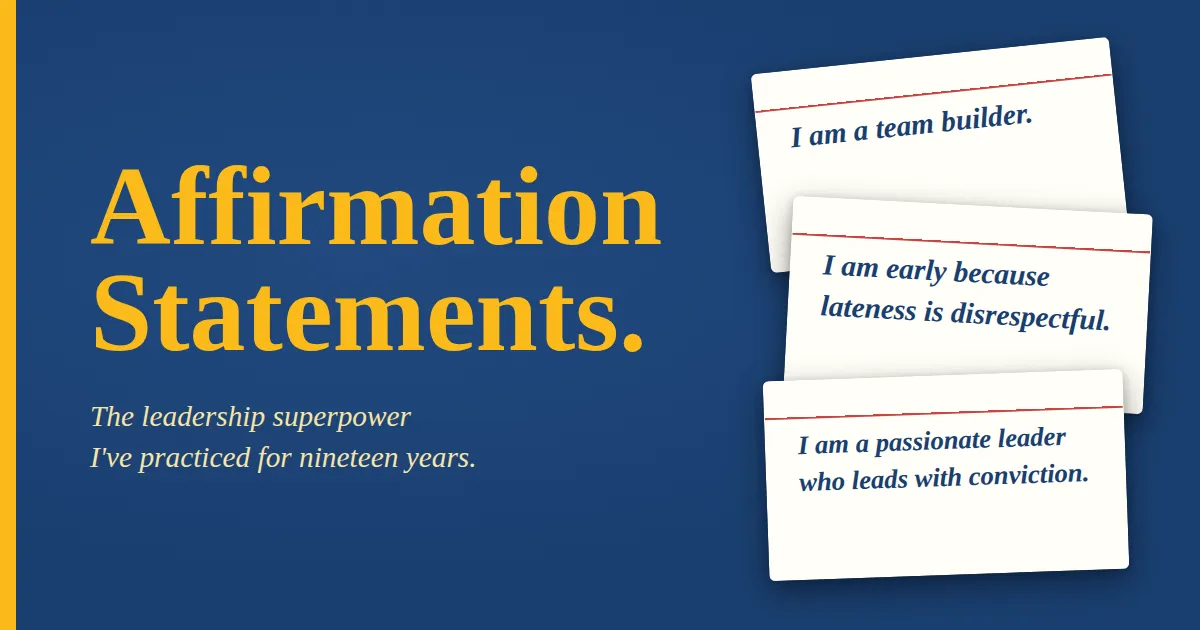
Personal.Who am I as a man, a husband, a father, a leader, a follower of Jesus? My personal list covers all of this. It includes identity statements like *”I am a passionate leader who leads with unwavering conviction.” It includes daily habits like “I rise every day at 4:00 AM with vigor”and“I am early for everything because being late is disrespectful.”It includes outcomes like“I make one million dollars a year.”And it keeps Earl’s original four, the ones I picked up nineteen years ago and have never let go of:I feel happy. I feel healthy. I feel terrific. I will touch someone’s life today.
Family. My wife and I speak the daily affirmations over Abby together. It started with me. Now it is a shared rhythm. I also try, every single day, to speak at least one affirmation over my wife. To name out loud, to her face, something I appreciate about her. I have a reminder on my phone that goes off and makes me stop and think of one thing. It started as a discipline. It has become one of the most important habits in our marriage. She knows I see her, because every day I say one piece of what I see out loud.
Company. Beratung Advisors has institutional affirmations that mirror our core values and vision.We serve our clients. We are for our clients. We lead the way among planning firms.I read these as a leader, and they shape how I run the firm. Some of the people on my team have started building their own. The practice is contagious when it is real.
You do not have to do all three at once. Start with personal. Three statements. Live them for thirty days. Add family next quarter. Add company when the company is ready. The order matters less than the start.
The Thirty-Day Challenge
This is the offer I make to every leader I introduce to this practice. Take it.
Thirty days. One affirmation. Read it three times a day, out loud. That is the whole experiment.
If you come back to me at the end of the thirty days and tell me it did not work, that you did it faithfully and felt no change, I will never talk to you about affirmation statements again. I will let it go. I will not bring it up.
I have made this offer to more than one hundred leaders over nineteen years. Nobody has come back. Nobody. Some have come back to add to their list. Some have come back to thank me. Nobody has come back to say it did not work.
In nineteen years and a hundred leaders, nobody has come back to tell me it did not work.
I am not trying to oversell this. I am telling you what I have observed. The reason it works is not because I am special, or because I am persuasive, or because the leaders I am talking to are particularly disciplined. It works because the mechanism works. Auto-suggestion is real. The white bear is real. Compounding identity is real. When you point them at the right target, the target hits.
So take the challenge. Pick one statement. Write it down. Read it three times a day, out loud, for thirty days. Then we will compare notes.
Where to Start
You have read this far, which means you are at least curious. Here is the next step, in order.
Seek God for discernment.Always start here. Ask Him what He wants for you in this season. The right affirmations are not the ones you can dream up. They are the ones that align with who He made you to be.
Sphagetti. Open a blank page. For five minutes, write every “I am” statement that comes to mind. Identity statements. Habit statements. Outcome statements. Do not filter. Twenty ideas is fine. Forty is better.
Pink three. One identity, one habit, one outcome. The most important one in each cluster. Cross out the rest, for now.
Strengthen each one. Rewrite the three using the grammar above. Present tense. Specific. Add a reason or a date.
Write them somewhere durable. Card. Notebook. App. Where you will see them tomorrow morning.
Read them three times a day, out loud, for thirty days.Set an alarm if you have to. The dose is what compounds.
Share them with one person this week.Spouse, accountability partner, mentor, pastor. By Friday. Lock the commitment in public.
At day thirty, evaluate.Did anything change? Add a fourth statement if it did. Refine the three if they need it. Stay the course if they do not.
That is the whole practice. Eight steps. Most people quit somewhere around step four because they think it is too small to matter. It is small. The compound is what matters.
My Twenty-Five Today
For what it is worth, here is my whole list as it stands today. Nineteen years in. I read these every morning, out loud, in my office before the building fills up.
Who I Am
I am a passionate leader and lead with unwavering conviction and by my actions.
I am a loving husband and father. I prioritize my wife and children.
I am a team builder.
I lead others by serving them and helping them maximize their talents and growth.
I am a good steward of the money God has entrusted me with.
I am one of the baptized, and God has special plans for me and my business.
I mentor other financial advisers and men.
My passion for financial planning exudes from me.
I feel happy. I feel healthy. I feel terrific.
I will touch someone’s life today.
How I Live
I rise every day at 4:00 AM with vigor to start a new opportunity.
I am early for all events in life because it is disrespectful and rude not to be.
I do not swear or use vulgar language.
I watch my spending and do not spend frivolously.
I work out daily and prioritize working out.
I watch what I eat and track everything I eat to live longer.
I track my hours, my habits, my time with family, and the food I eat, so I can stay focused and live my life as called.
I educate myself daily and have an unquenchable thirst for knowledge.
I pray daily over my clients, teammates, family, and friends.
I lift all my joys, sorrows, and struggles to God.
What I Build
I run Beratung Advisors, a ten million dollar revenue firm.
I make one million dollars a year.
Beratung Advisors leads the way among planning firms, and advisors want to join the team.
Beratung Advisors serves our clients and is for our clients.
Beratung Advisors is innovative with a compelling vision for the future.
Some of these are true today. Some are aspirational. I do not split hairs about which is which. I read them all as “I am,” present tense, every morning. Over the years the gap between aspiration and reality closes. That is the whole point.
One Last Thing
When I sit with leaders who have done the foundational five exercises and they ask me what is next, I tell them this. The foundational five are documents. They tell you who you are and where you are going. Affirmation statements are the daily practice that turns those documents into who you aretoday. Without the practice, the documents collect dust. With the practice, the documents become flesh.
Earl gave me four statements in 2006. I have been reading them ever since. They have not made me a better salesperson, exactly. They have made me an unshakeable one. Clients tell me they trust me. They tell me they can feel I believe what I am saying. They are right. I do believe it. I have read what I believe out loud, three times a day, for nineteen years. The belief is not performance. The belief is who I am.
The belief is not performance. The belief is who I am.
This can be true for you too. Start with three. Read them out loud. Share them with someone who will hold you to them. Take the thirty-day challenge.
If you want help building your three, join us at the Affirmation Statements Workshop on Wednesday, June 17th at 6:30 PM. One hour, with a workbook, with other leaders doing the same work. You leave with your three drafted and the next thirty days mapped out.
Multiply this by sharing it with another leader who needs to hear it.
Live Intentional.
Greg Furer
Founder and Visionary
Beratung Advisors & TeachPassion


