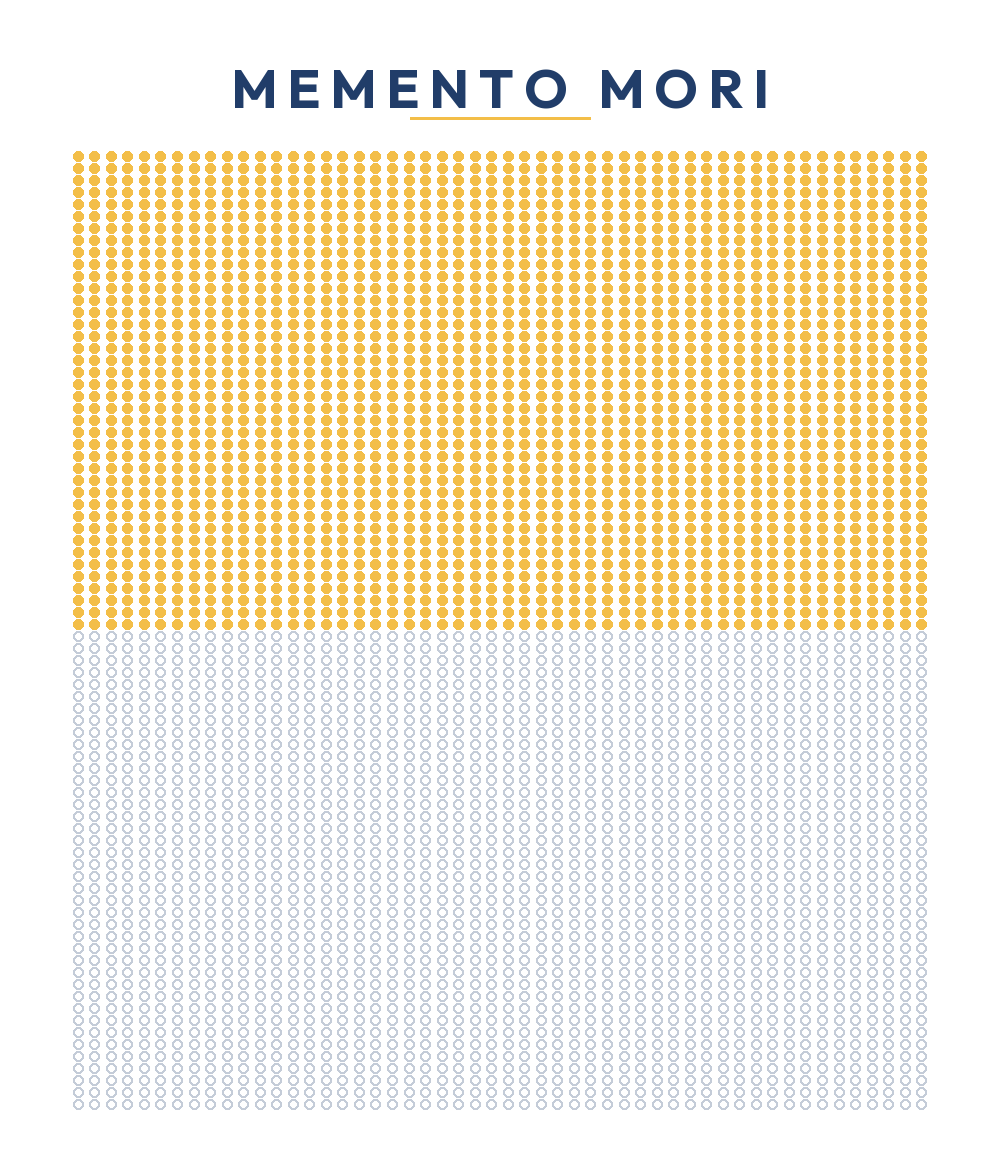
Momento Mori
How Many Weeks Do You Have Left?
Ask most people that and they cannot tell you. I can. As I write this, I have about 1,960 weeks left, give or take.
I can answer that because of a practice I have been doing for years. It is called a memento mori calendar. It is a single sheet of paper with one dot for every week in an eighty-year life. A little over four thousand dots. The dots are filled in for every week I have already lived. The rest are blank. It is a simple but powerful way to see how I have spent my time and how much of it I have left. Once a week, on Sundays, I fill in one more.
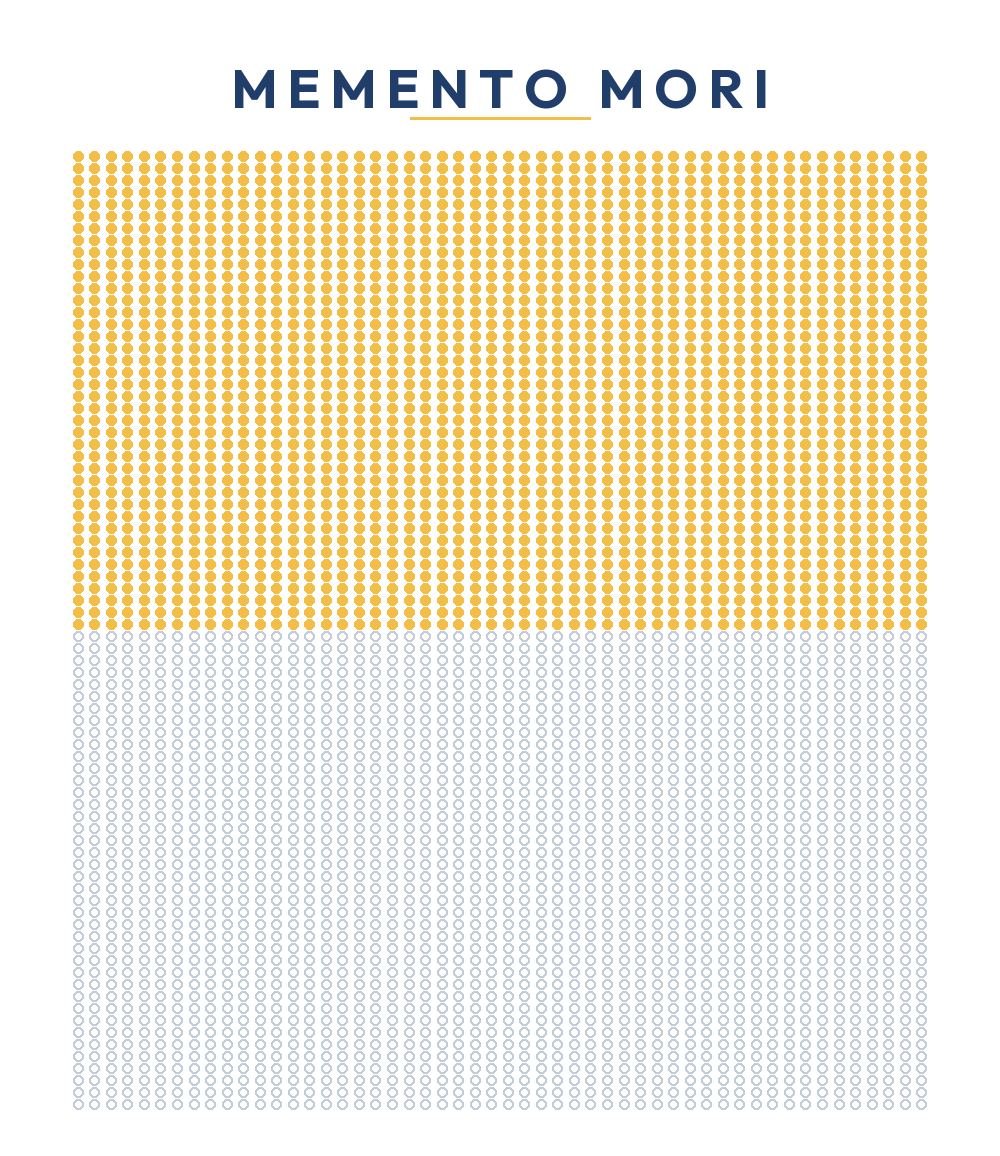
One dot for every week of an eighty-year life. The filled weeks are spent. The open ones are what is left.
This one habit has had a massive impact on my life. I do not fear death anymore. I have come to embrace it. It keeps me living intentionally, and it changes how I see every single week.
When I look at the dots behind me, I look back with joy. I think about the wins. Getting married. My daughter Abby being born. All the learning and the experiences that have compounded over the years. Then I look at how few dots are in front of me, and I start asking better questions. Do I want to waste this one? Will this dot matter? Will it compound toward the person God is calling me to be?
Time is one of the greatest assets we have, and the reason is compounding. We all understand compounding when it comes to money. It works exactly the same way with learning and with experience, week over week and year over year. We obsess over compounding our money. Almost nobody thinks to compound their weeks. Count your weeks, not your money. So how am I going to spend this week's dot? Maybe I wasted last week's. The real question is whether I can keep from wasting the next one.
Where I Got It
I knew about memento mori for years before I ever filled in a dot. Knowing about something and doing it are two different things, and most of us stop at knowing.
What finally moved me was a book. Sahil Bloom's The 5 Types of Wealth was one of the best things I read last year. The first kind of wealth he names is not money, it is time. You get a fixed number of hours, you cannot earn more of them, and what you do with them is the whole game. The Psalms have been saying the same thing for thousands of years. Teach us to number our days, that we may gain a heart of wisdom. I closed the book, printed the calendar, and started numbering.
What It Does to You
The first time you see your whole life on one page, you cannot look away, and you cannot argue with it. The weeks that are gone are gone.
For a lot of people that thought is terrifying, so they spend their whole lives running from it. It does not have to be that way. I do not fear death, because of what Jesus did with it. You are going to die, and in Christ that is not the end of your story. Nothing, Paul writes in Romans 8, not even death, gets between you and the love of God. The grave is real. It is just not final. Once you actually believe that, a page full of your remaining weeks stops being a threat and starts being a gift.
It also frees you from chasing the wrong thing. Most of what we call ambition is just success, and success is an outside game. It is measuring your life against the next guy, his title, his truck, his numbers, and you can never win it, because there is always a bigger boat. Excellence is the opposite. Excellence is measuring your life against what God actually called you to. Stop chasing success, start chasing excellence, and the success tends to follow on its own. Looking your own death in the eye is what frees you to make that trade.
The Retreat
I have started building this calendar into a men's retreat I run. I built the retreat on five truths, the same five I first went through years ago at a retreat of my own. They come from Richard Rohr and his work on male initiation, mostly his book Adam's Return:
1. Life is hard.
2. You are going to die.
3. You are not important.
4. You are not in control.
5. Your life is not about you.
On the retreat, the men go out into the woods and spend hours alone with God, working through these truths with the Scriptures. When we get to the second one, you are going to die, each man is handed a counter I have already filled in with his own dots, by hand, using his real age. Holding your whole life on one page, out in the quiet with God, does something a talk from the front of a room never could. At the end, I give him a fresh one to keep filling in on his own.
I fill theirs in for that moment because I know from my own how much that first fill matters. When I sat down to fill in my own calendar the first time, it took me the better part of a month. I did it in pieces, a couple of sittings a week, about five years at a time, stopping to actually remember what happened in each stretch of my life. That slow walk backward through the decades was every bit as powerful as the weekly dot has been since. Do not rush past it. Filling in the weeks you have already lived is half the practice.
Start With the End in Mind
There is one more thing I keep next to my calendar and read every week. My own obituary. The practice of writing one comes from Stephen Covey's The 7 Habits of Highly Effective People, from the habit he calls beginning with the end in mind. Covey has you picture your own funeral. The flowers, the people you love sitting in the chairs, somebody standing up to give the eulogy. What are they saying about you? Your net worth? The hours you logged? Or who you actually were to them?
That picture is why I wrote my own obituary years ago, and why I rewrite it every year and read back through the old ones in my year-end review. I walk leaders through the same exercise every year at our TeachPassion Summit, and this year we had a room full of them write their own. I put the whole how-to in its own post, my own obituary included, so I will link it here for anyone who wants to do the work: [link: How to Write Your Own Obituary].
Set your obituary next to your calendar and ask one question. The way I am spending these weeks, am I building toward that, or toward some other ending I never chose?
Print It by Hand
When you do this, print it on paper and fill it in with a pen. And do not, whatever you do, let ChatGPT fill it in for you, or hand you a clean version with the dots already colored. It can do that in two seconds, and that is exactly why you should not let it. The point is your own hand moving across the weeks you have already spent. That is the work. Letting a machine do it is like paying somebody to go to the gym for you and wondering why nothing changed.
This is what living intentionally comes down to. Spending this week's decisions on purpose, pointed at where God is taking you, instead of drifting and hoping it works out. The calendar will not let you drift.
So print it. Fill in the weeks you have already lived, and take your time doing it. Then once a week, fill in one more, and take a long look at the ones you have left. Spend them on the life God actually called you to, and one day you will hear, well done, good and faithful servant.
Download the calendar for free and start this week: Download the Memento Mori Calendar.
Live Intentional.


